CVE-2026-93656 vulnerability and BitFire protection

How BitFire Blocks CVE-2026-93656: Profile Builder XSS

WordPress vulnerability research

BitFire's FREE WAF blocks CVE-2026-93656's payload-bearing request before Profile Builder can persist it or an administrator's browser can run it.

Subscriber+ authentication CVSS 6.4 (Medium) Script execution in admin sessions Stored cross-site scripting
BitFire · Vulnerability advisoryResearch published
AdvisoryCVE-2026-93656
ComponentUser Profile Builder – Beautiful User Registration Forms, User Profiles & User Role Editor
Relevant sourcefront-end/default-fields/upload/upload_helper_functions.php — wppb_default_fields_make_upload_button() (persistence chain begins in front-end/default-fields/avatar/avatar.php)
Executive summary

What WordPress administrators need to know

Profile Builder 4.0.2 and earlier let a logged-in subscriber turn one crafted profile-page request into script execution in an administrator's browser. The plugin's field renderer accepts raw request data during a nonce-free page load, stores the supplied string verbatim as an attachment GUID, and later echoes that GUID and title into the admin Edit User screen without escaping. The result is authenticated stored cross-site scripting that runs inside wp-admin under a privileged session (CVSS 6.4, changed scope). BitFire FREE's WAF detects the malicious payload in the incoming request and blocks it before WordPress can persist anything, and BitFire Threat Hunter hunts the backdoors, triggers, and droppers an earlier compromise may have left behind.

At a glance

Key facts

  • Authenticated (Subscriber+) stored XSS reachable through a nonce-free GET to /wp-admin/profile.php when an Avatar or Upload field is configured.
  • The render path hands raw $_REQUEST to the field handler and stores the attacker's string verbatim as an attachment GUID.
  • Attachment GUID and title are echoed without esc_url() or esc_html() on the administrator's Edit User screen.
  • Version 4.0.3 ends persistence during rendering, validates legacy attachment URLs, verifies saved attachment IDs, and escapes all upload-field output.
  • BitFire FREE's WAF detects the script payload in the query string and blocks the exploit before WordPress processes it.
  • Affects Profile Builder 4.0.2 and earlier; fixed in 4.0.3 — update now and investigate any site that ran the vulnerable line.
01
Vulnerability overview

Understand the exposure

The affected component, attack path, and practical risk for WordPress websites.

Affected componentUser Profile Builder – Beautiful User Registration Forms, User Profiles & User Role Editor
Potential reach40,000+ installations
Attack techniquecross-site scripting
Published2026-09-24
BitFire's FREE WAF stops CVE-2026-93656 at delivery: the script payload never survives query-string inspection, so it is never persisted and never executes in an administrator's browser.
02
Technical analysis

How the vulnerability works

Research details, affected versions, exploitation behavior, and remediation guidance.

A Nonce-Free GET Request That Writes, Then Executes

CVE-2026-93656 starts with an ordinary account and an ordinary page. /wp-admin/profile.php is available to every logged-in user, and rendering it passes the raw $_REQUEST superglobal into each field handler in front-end/default-fields/fields-functions.php. No nonce guards this render. When an Avatar field is configured, a query-string key matching the field's meta-name reaches wppb_avatar_handler, which in 4.0.2 stores the supplied string verbatim as a new attachment's GUID and repoints the user's meta at it — writes performed on a plain GET. The trap springs later: when an administrator opens Users → Edit for that account, wppb_default_fields_make_upload_button() concatenates wp_get_attachment_url() — the stored GUID — and get_the_title() into HTML without esc_url() or esc_html(). The subscriber's payload then executes under the administrator's session inside wp-admin.

BitFire FREE WAF: Blocked Before WordPress Runs

The exploit's only delivery vehicle is one HTTP request carrying the malicious script payload in its query string — exactly what BitFire FREE's Web Application Firewall inspects. Before WordPress or Profile Builder processes anything, the WAF evaluates the URL and query string, detects the JavaScript injection content, and blocks the request outright. Blocked at delivery, the attack has no next step: no attachment record is created, no user meta is repointed, and no payload is stored for an administrator's browser to execute. This is behavior-based detection, not a CVE-specific virtual patch, so coverage does not wait on a signature. The payload cannot function unless it reaches the vulnerable code, and the WAF makes sure it never does. Request filtering ships in BitFire FREE for eligible non-commercial sites; commercial sites need the appropriate commercial license.

The 4.0.3 Patch Closes the Chain at Every Stage

Profile Builder 4.0.3 dismantles the chain at every stage. Field rendering no longer converts request data: a $from_request check gates attachment conversion, so a render cannot persist input. The surviving conversion path, wppb_legacy_file_url_to_attachment(), accepts a URL only when it resolves by realpath inside wp_upload_dir()'s basedir with a resolvable filetype, stamps post_author, and sanitizes the title — rejecting arbitrary strings and eliminating the authorless attachments 4.0.2 created. Upload-field output is fully escaped with esc_attr(), esc_url(), and esc_html(), neutralizing anything previously stored, and the avatar save path now persists through wppb_save_attachment_id(), which demands a numeric, owned attachment ID. Update to 4.0.3 immediately; the fix needs no configuration changes.

If Your Site Was Affected, Investigate for Persistence.

Patching closes the known path; it does not undo a compromise that already happened. If your site ran Profile Builder 4.0.2 or earlier with an Avatar or Upload field, any subscriber could have planted a payload, and a single administrator view of that profile was enough to execute it in a privileged session. A clean file scan proves nothing. Run BitFire Threat Hunter to surface what this class of compromise leaves behind: backdoor WordPress administrator accounts, hidden database triggers, long-running PHP processes, and droppers that can restore malware or reinfect the site. Remove every persistence mechanism found and rotate administrator credentials immediately.

Patch, Verify, and Stay Protected With BitFire

CVE-2026-93656 shows how a low-privilege account can reach high-privilege browsers through one unescaped echo. BitFire FREE's WAF stops the payload-bearing request before WordPress runs, and BitFire Threat Hunter verifies nothing was left behind if your site was exposed. Update Profile Builder to 4.0.3, install BitFire, and make request-layer protection plus post-compromise investigation part of your WordPress baseline. If you ran an affected version, patch, investigate for persistence, and rotate credentials today — with BitFire on your side.


03
Source review

Vulnerable and fixed code

The relevant source is located in front-end/default-fields/upload/upload_helper_functions.php — wppb_default_fields_make_upload_button() (persistence chain begins in front-end/default-fields/avatar/avatar.php).

BeforeVulnerable behavior
// front-end/default-fields/fields-functions.php: every field render receives raw request data
$admin_fields .= apply_filters( 'wppb_admin_output_form_field_'.Wordpress_Creation_Kit_PB::wck_generate_slug( $value['field'] ), '', 'back_end', $value, $user->ID, array(), $_REQUEST );

// front-end/default-fields/avatar/avatar.php (4.0.2): request value persisted during render
$input_value = $request_data[wppb_handle_meta_name( $field['meta-name'] )];
'guid' => $input_value,
update_user_meta( $user_id, $field['meta-name'], $input_value );

// front-end/default-fields/upload/upload_helper_functions.php (4.0.2): stored GUID and title echoed unescaped
// ( $attachment_url = wp_get_attachment_url( $value ); $file_name = get_the_title( $value ); )
$upload_button .= "<a href='{$attachment_url}' target='_blank' class='wppb-attachment-link'>" . $thumbnail . "</a>";
$upload_button .= $file_name;
AfterCorrected behavior
// Corrected behavior, abridged from the supplied writeup.
// front-end/default-fields/avatar/avatar.php (4.0.3): rendering never persists request input
if ( ! $from_request ) {
    // only legacy user-meta URLs are delegated to the validated helper
}

// front-end/default-fields/upload/upload_helper_functions.php (4.0.3):
// wppb_legacy_file_url_to_attachment() accepts a URL only when realpath() places it inside
// wp_upload_dir()['basedir'] with a resolvable wp_check_filetype() mime, sets
// 'post_author' => $user_id, and stores a sanitize_text_field() title

// shared render output is now escaped
$upload_button .= "<a href='" . esc_url( $attachment_url ) . "' target='_blank' class='wppb-attachment-link'>" . $thumbnail . "</a>";
$upload_button .= esc_html( $file_name );
04
Zero-day protection

Protection from the first exploit request

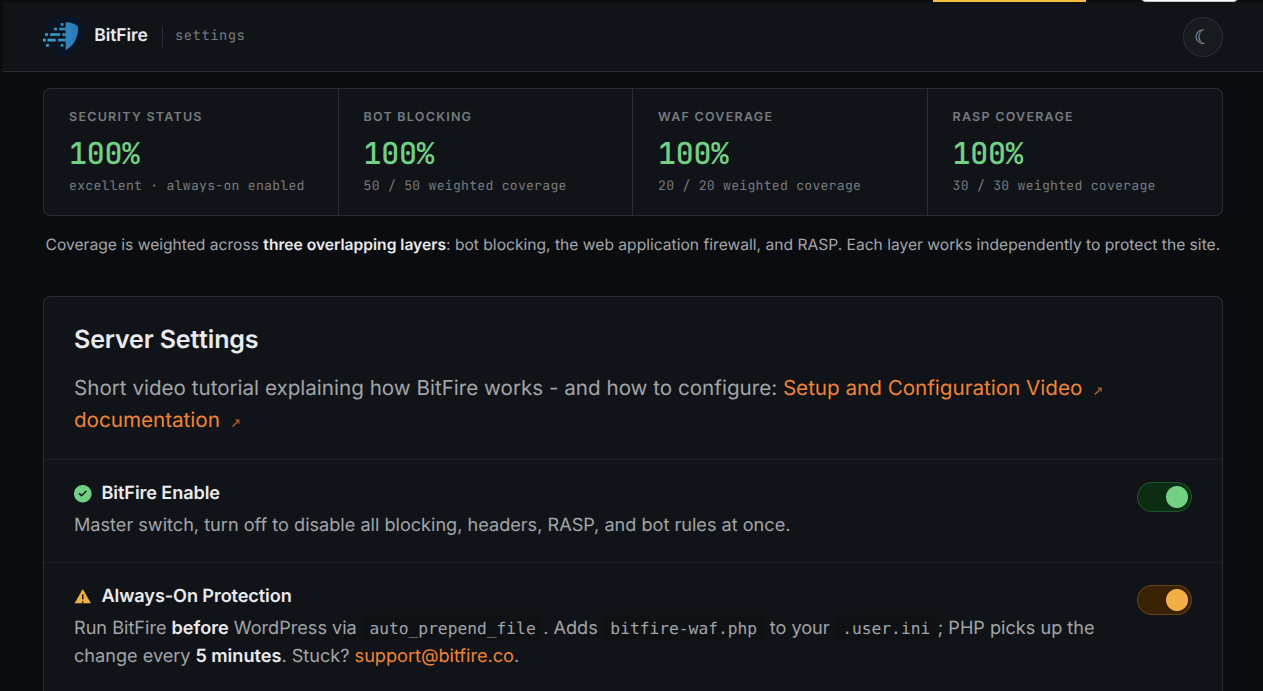
BitFire protects WordPress servers on day zero—before a vulnerability is publicly known and before other vendors have time to develop signatures or patches.

01 · VerifyStop unknown clients

Bot controls and browser verification stop untrusted automated clients before previously unknown exploit code reaches WordPress.

02 · DetectBlock malicious behavior

General WAF protections identify dangerous request behavior and hostile payloads without waiting for a vulnerability-specific signature.

03 · PreventContain attacks at runtime

RASP follows execution inside PHP and prevents unauthorized changes to protected files, accounts, and database content.

BitFire · WordPress protectionZero-day ready
BitFire zero-day WordPress vulnerability protection
BitFire combines verified-client controls, behavior-based WAF detection, and runtime RASP enforcement to protect WordPress before an exploit has a name, CVE, signature, or vendor patch.
About the author

Cory Marsh

Cory has more than 20 years of internet security experience and is a lead developer on the BitFire project.

Read BitFire security research →
Protect your WordPress website

Add protection before the next exploit arrives.

BitFire combines bot controls, request inspection, malware detection, and runtime protection in one WordPress security platform.

Protect my site free →