How an Untrusted Post Becomes an Administrator Account
JetFormBuilder registers its submission flow for logged-in and anonymous traffic. The attacker supplies `_jet_engine_booking_form_id`; the plugin applies only `absint()`, loads that post, and passes its content to `parse_blocks()` without confirming it is a `jet-form-builder` post. Exploitation therefore requires a post whose content the attacker can influence, such as content accepted by a guest-post or listing plugin, plus its enumerable numeric ID. A planted field can declare an `ssr` Advanced Validation callback named `wp_insert_user`. JetFormBuilder passes the submitted field array into that function, which performs no capability check, creating the requested administrator account as a validation side effect.
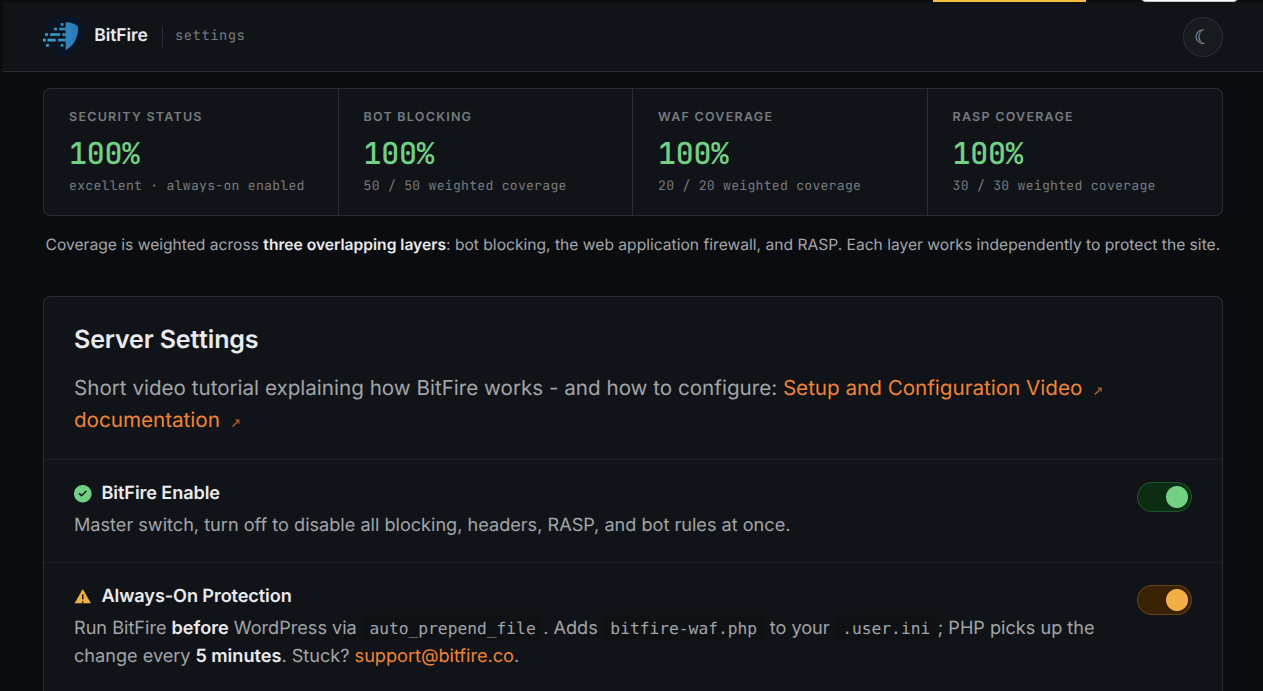
BitFire FREE Blocks Automated Exploit Delivery
The attack is delivered through a POST to JetFormBuilder's public AJAX endpoint or reload submission path. BitFire FREE Bot Protection blocks known scanners and unknown or restricted bots from submitting forms, posting data, or calling sensitive APIs. Clients presenting as browsers must pass lightweight JavaScript verification before the request reaches WordPress, stopping scripts and fake browsers that attempt to enumerate post IDs and trigger the malicious schema. This protection operates before vulnerable plugin code runs. A deliberately allowlisted bot or successfully verified client is not automatically blocked at this layer, while BitFire PRO RASP still enforces the protected runtime operation.
BitFire PRO RASP Prevents Administrator Creation
BitFire PRO RASP stops the exploit at its decisive sink. When vulnerable validation code calls `wp_insert_user()` with an administrator role, database protection evaluates the attempted user creation and privilege assignment against the requester's authority. Because the request is unauthenticated, RASP blocks the unauthorized account creation and administrator-role assignment. The attacker receives no privileged account to use for login, plugin installation, file editing, or takeover. RASP does not sanitize the attacker-selected form ID or rewrite the validation rule; it independently denies the dangerous database outcome even after the plugin's trust-boundary checks have failed.
If Your Site Was Affected, Investigate for Persistence.
Version 3.6.2.1 adds a `manage_options` check to the related JetEngine Update Options action, but the supplied comparison found the untrusted schema parser and blacklist-based callback path unchanged. Upgrade beyond 3.6.2.1 to a release that validates form origin and allow-lists server-side callbacks. Patching closes a path; it does not remove an earlier compromise. Run BitFire Threat Hunter to find backdoor WordPress administrator accounts, hidden database triggers, long-running PHP processes, and droppers that can restore malware. Review submission logs and unexpected `ssr` block markup, remove every persistence mechanism discovered, and rotate relevant credentials.
Deploy Layered BitFire Protection Now
CVE-2026-12793 turns a missing schema-origin check into complete WordPress takeover, but BitFire breaks the chain. BitFire FREE blocks automated form and AJAX delivery before JetFormBuilder executes it. BitFire PRO RASP blocks unauthorized administrator creation if the request reaches runtime, and Threat Hunter exposes persistence left by an earlier breach. Deploy BitFire, replace vulnerable JetFormBuilder releases with a version that fully corrects the root cause, and investigate every previously exposed site. Do not treat the narrower 3.6.2.1 options-write hardening as complete remediation.