CVE-2025-7340 Turns a Public Upload Into a Critical Risk
HT Contact Form Widget registers its temporary upload action for visitors who are not logged in. In versions through 2.2.1, `temp_file_upload()` verifies only whether PHP reported an upload error. It sanitizes the supplied filename and moves the file into the plugin's temporary directory, but it does not reject executable file types. An unauthenticated attacker can therefore submit a PHP payload. If that uploaded file is reachable and executable under the server's configuration, the attacker may run code remotely, access WordPress data, install persistence, or use the site to attack other systems. That pre-authentication path and potential impact account for the critical 9.8 CVSS score.
Update HT Contact Form Widget to Version 2.2.2 or Later
Version 2.2.2 adds a `wp_check_filetype()` test before `move_uploaded_file()` writes the temporary upload. Unrecognized and disallowed file types are rejected instead of being stored on the server. Administrators should update immediately rather than treating a firewall as a substitute for patching. Because an update does not remove files uploaded before remediation, also inspect `wp-content/uploads/ht_form/temp` and the rest of the uploads tree for unexpected `.php`, `.phtml`, or other executable files.
Layer 1: Bot Blocking Stops Automated Exploit Code
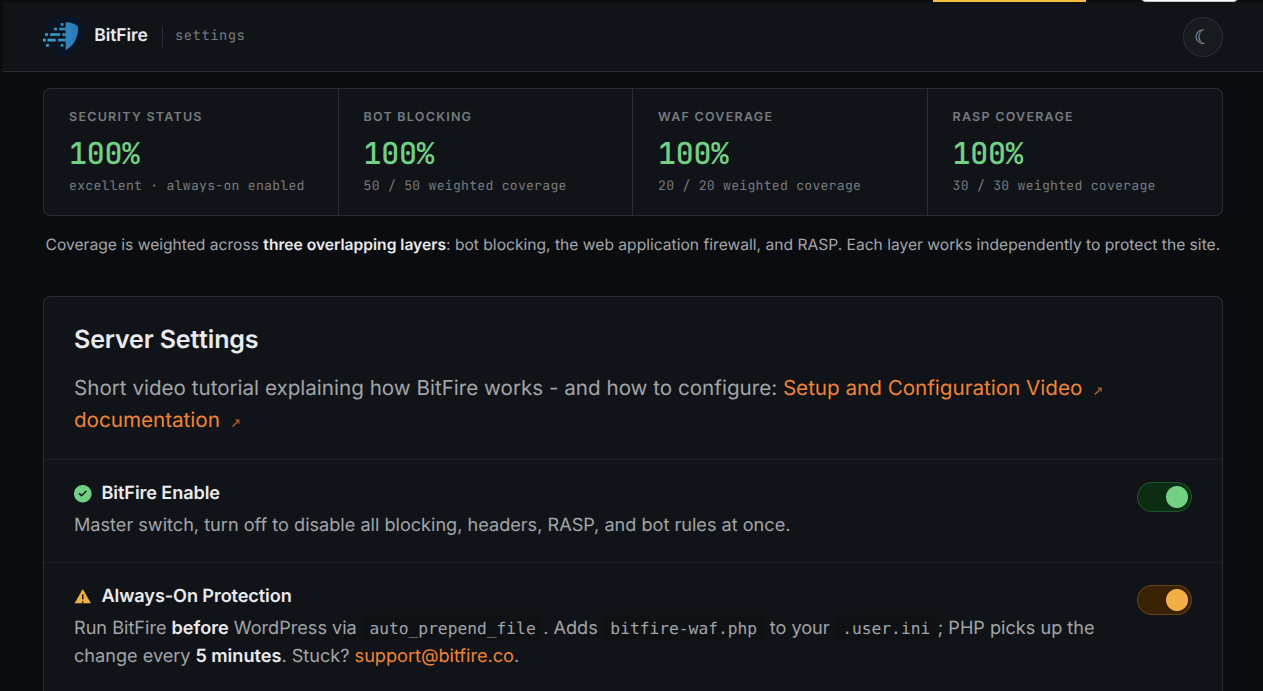
Exploitation begins with a scripted file-upload request. BitFire's bot protection identifies unknown automation, vulnerability scanners, and exploit tools before they can deliver that request to WordPress. Legitimate integrations can be allowed, while untrusted bots are denied the ability to probe and repeatedly attack the public upload action. This first layer reduces exposure without depending on a CVE-specific signature.
Layer 2: The BitFire WAF Rejects Unauthenticated PHP Uploads
If a request reaches the application boundary, BitFire's WAF independently inspects its authentication context and uploaded attachments. An unauthenticated client is not allowed to attach a PHP file to the request, so the malicious payload is blocked before the vulnerable plugin can pass it to `move_uploaded_file()`. This control targets the dangerous behavior required by the exploit and can protect a site before a vulnerability-specific rule is available.
Layer 3: BitFire RASP Prevents Unauthorized PHP File Changes
BitFire PRO RASP provides the final barrier where the attack must ultimately succeed: the server filesystem. Its operating-system-level enforcement prevents non-administrators from creating or modifying PHP files. Even if an attacker bypasses bot controls and request inspection, the attempted PHP write is denied instead of becoming a web shell. This layer protects the outcome, not merely the appearance of the incoming request.
Three Independent Layers Protect the Site Before and After Patching
CVE-2025-7340 succeeds only if the exploit request arrives, the PHP attachment reaches the vulnerable handler, and the server permits an unauthorized executable file change. BitFire breaks each requirement with a separate control: bot blocking, WAF upload enforcement, and PRO RASP. Update to version 2.2.2 or newer, review existing files and security logs, and use BitFire PRO RASP to keep PHP code protected even when an unknown plugin vulnerability reaches the server.